

Many animals are more sensitive than we realize.
Some animals become anxious when there are loud sounds, unfamiliar people, travel, storms, fireworks, changes in routine, visits to the veterinarian, or tension in the home. Some animals have experienced rescue, rehoming, illness, neglect, loss, or uncertainty. Others seem to feel the world deeply from the beginning. They may startle easily, hide often, resist touch, become overstimulated quickly, or need extra time to trust.
When we love an anxious or sensitive animal, we naturally want to help. We may want to comfort them, calm them, hold them, reassure them, or make the fear go away. This impulse usually comes from love. But anxious animals often need something very specific from us: not more intensity, but more spaciousness.
This is where Animal Reiki can be such a beautiful support.
Animal Reiki offers a calm, compassionate field of healing energy without requiring the animal to be touched, handled, controlled, or made to behave in a certain way. It allows the animal to receive in their own timing, from their chosen distance, and according to their own sense of safety.
For anxious or sensitive animals, this matters deeply.
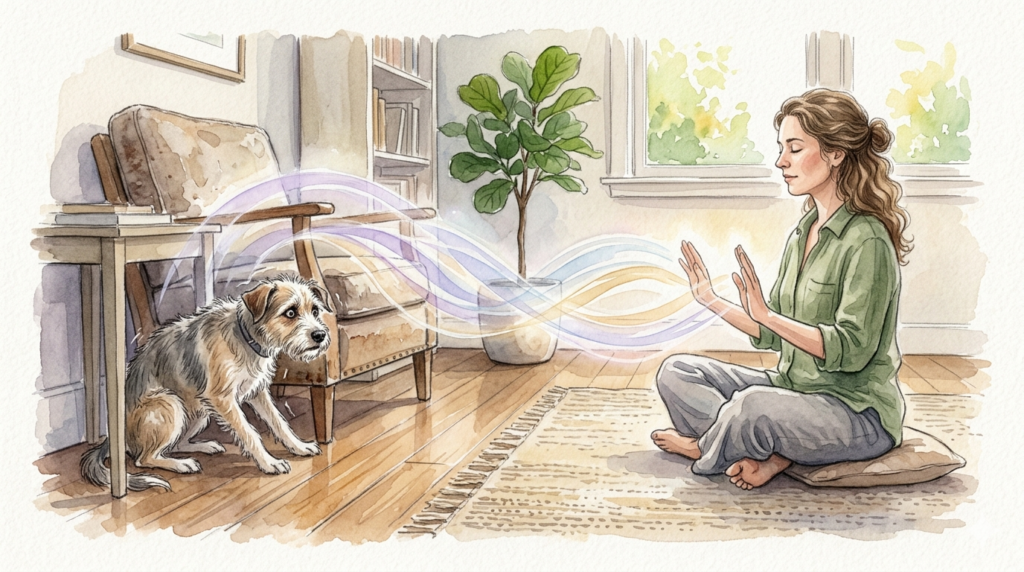
Can Reiki Help Anxious Animals?
Reiki can be a gentle support for anxious animals because it helps create a peaceful atmosphere. It does not force the animal to change. It does not demand immediate calm. Instead, Reiki invites softness into the shared space between the animal and the human.
An anxious animal may be living in a heightened state of alertness. Their body may be watching for danger. Their senses may be tuned to sound, movement, scent, emotional tone, or unfamiliar energy. If they have experienced trauma, instability, or fear, they may need time before they feel safe enough to relax.
Animal Reiki does not require us to know the animal’s entire story. It asks us to become a steady presence.
When Reiki fills the space, the animal may begin to feel that nothing is being demanded of them. They are free to come closer or move away. They are free to rest, watch, hide, pace, or receive from a distance. This freedom can help build trust.
The goal is not to make the animal calm on command. The deeper intention is to offer a field of peace where the animal’s own system may soften when ready.
Sensitive Animals Do Not Need Pressure
One of the most important things to understand is that anxious animals often feel pressure easily.
They may feel pressure when we stare at them too much.
They may feel pressure when we move toward them too quickly.
They may feel pressure when we want them to relax before they are ready.
They may feel pressure when our own worry becomes intense.
This can happen even when we are trying to help.
In Animal Reiki, we learn to soften our effort. Instead of thinking, “I need to calm this animal down,” we shift into, “I will hold Reiki in this space and allow the animal to choose.”
That shift changes the energy of the session.
The practitioner is no longer trying to make something happen. The animal is no longer the object of our concern or concentration. Reiki becomes an offering rather than a force. The space becomes safer because the animal is not being asked to perform calmness.
This is one of the reasons distance can be so helpful in Animal Reiki. An anxious animal may receive more easily from across the room than from someone sitting beside them. They may feel safer when they are not being touched. They may relax more when they know they can leave.
Should You Touch an Anxious Animal During Reiki?
In most cases, it is best not to begin Animal Reiki with touch when working with an anxious or sensitive animal. Touch may be comforting for some animals, but for others it can feel overwhelming, especially if they are fearful, guarded, ill, overstimulated, or unfamiliar with the practitioner.
Animal Reiki does not require touch.
This is very freeing. You can sit quietly in the same room, outside a kennel, near a stall, or at a respectful distance. You can invite Reiki to flow and allow the animal to decide whether they want to come closer.
If the animal chooses to approach and clearly seeks contact, touch may become appropriate, depending on the situation and the animal’s comfort. But the animal should lead. The practitioner should remain observant, gentle, and willing to stop if the animal moves away or shows signs of discomfort.
Anxious animals often need to know they will not be forced. When we respect that, trust can begin to grow.
Can Animals Receive Reiki From a Distance?
Yes. Animals can receive Reiki from a distance, and many anxious animals prefer it this way.
Distance may mean sitting across the room. It may mean offering Reiki from outside a stall, kennel, or enclosure. It may mean offering Reiki while the animal rests in another part of the house. It may also include formal distant Reiki practice when the animal is not physically present.
This is one of the great blessings of Animal Reiki. The animal does not need to be close to receive. They do not need to lie under your hands. They do not need to look peaceful in a way that satisfies the human mind. Reiki is not limited by physical closeness.
For anxious animals, distance can communicate respect. It says, “You are safe. You do not have to come closer than you want to. You may receive in your own way.”
That message can be healing all by itself.
Reiki for Rescue Animals
Rescue animals may carry histories we do not fully know. Some have experienced neglect, abandonment, fear, frequent transitions, harsh handling, illness, or emotional uncertainty. Others may not have been abused but may still feel overwhelmed by change.
When working with rescue animals, Reiki can be especially supportive because it is non-invasive. There is no requirement for the animal to trust immediately. There is no need to touch. There is no pressure to respond.
This makes Reiki a beautiful complement to patient care, appropriate veterinary support, compassionate training, stable routines, and safe environments.
A rescue animal may hide during Reiki. They may watch from a doorway. They may sleep in another room. They may seem uninterested. They may approach only after several sessions. They may never choose close contact during Reiki and still benefit from the peaceful space.
The practitioner’s role is to remain consistent and respectful.
Rescue animals often teach us patience. They remind us that trust is not something we take. Trust is something we are invited into.
Begin With Yourself
When offering Reiki to an anxious animal, begin with yourself.
This may be the most important part of the session.
If you are worried, tense, frustrated, or desperate for the animal to relax, the animal may sense that. Animals are often highly aware of emotional tone. They may not understand your thoughts, but they may feel your urgency.
Before offering Reiki outward, allow Reiki to flow through you.
Let your breath slow.
Let your shoulders soften.
Let your heart become steady.
Let your intention become simple.
You might silently say, “May Reiki fill this space for the highest good. May this animal receive only in the way that is right for them.”
This helps you release the need to control the outcome.
You are not there to fix the animal. You are there to offer Reiki with love, humility, and trust.
What If the Animal Hides During Reiki?
If an animal hides during Reiki, do not assume the session has failed.
Hiding may be the animal’s way of feeling safe. They may still be aware of the Reiki space. They may be listening from a distance. They may be receiving in a way that is invisible to you.
With anxious animals, hiding can be respected as a boundary.
You do not need to coax them out. You do not need to move closer to their hiding place. You do not need to prove that Reiki is working. Simply remain peaceful. Offer Reiki into the shared space. Let the animal decide.
Over time, the animal may choose to come out. Or they may continue receiving from their safe place. Either way, your respect helps build trust.
Signs an Anxious Animal May Be Receiving Reiki
Animals may show subtle signs of receiving Reiki. These signs can vary, and it is important not to force interpretation. But you may notice changes such as softer eyes, slower breathing, yawning, stretching, sighing, lying down, becoming quieter, moving to a comfortable resting place, or falling asleep later.
Some animals may move closer. Others may move farther away. Some may become active for a while before settling. Some may drink water. Some may seem to ignore you completely.
The key is to observe without attachment.
Rather than asking, “Is this working?” you might ask, “Am I holding the space with respect? Am I allowing the animal to choose? Am I staying present and steady?”
In Animal Reiki, the quality of the space matters.
Reiki and the Human-Animal Bond
Anxious animals often affect the humans who love them. Caring for a sensitive animal can bring up tenderness, worry, frustration, protectiveness, guilt, and exhaustion. You may wonder if you are doing enough. You may feel sad when your animal is fearful. You may become anxious because they are anxious.
Animal Reiki can support both of you.
When the human becomes calmer, the shared field may soften. When the human stops trying to force change, the animal may feel less pressure. When the human practices Reiki regularly, the home may begin to feel more peaceful.
This does not mean the human caused the animal’s anxiety. It simply means the bond is real. Animals and their people often influence one another emotionally and energetically.
Animal Reiki helps bring compassion into that bond.
It supports the animal.
It supports the human.
It supports the relationship.
Reiki as Part of a Supportive Care Plan
Animal Reiki is not a replacement for veterinary care, behavior support, training, medication, or environmental adjustments when those are needed. If an animal’s anxiety is severe, sudden, worsening, or connected to pain or illness, professional support is important.
Reiki can work alongside appropriate care.
It may help create calm before or after a veterinary visit. It may support an animal during a transition to a new home. It may help the human stay grounded during training or care routines. It may bring peace into the home during stressful seasons.
Reiki is one layer of compassionate support. It is not about ignoring practical needs. It is about bringing a steady, peaceful presence to the care already being given.
A Simple Animal Reiki Practice for Anxious Animals
Choose a quiet time when you and your animal are not rushed. Sit at a respectful distance. Let the animal have freedom to move away if possible. Avoid staring directly at them or calling them over repeatedly.
Place your hands comfortably in your lap. Take a few slow breaths. Invite Reiki to flow through you first. Allow your own body to soften.
Then silently offer Reiki into the room.
You might hold the intention: “May this space be filled with Reiki. May my animal receive only what is right for them, in the way that feels safe.”
Then allow.
Your animal may come closer. They may stay where they are. They may leave. They may hide. They may sleep. They may seem uninterested.
Let it all be okay.
Remain present for a few minutes. When the session feels complete, thank Reiki and thank your animal inwardly for sharing the space with you.
The simplicity of this practice is part of its strength.
Final Reflection
Reiki for anxious or sensitive animals is not about making an animal calm through force of will. It is about creating a peaceful, respectful space where the animal can feel choice, safety, and support.
Sensitive animals often do not need us to try harder. They need us to become steadier.
They need space.
They need patience.
They need consistency.
They need respect.
They need love without pressure.
Animal Reiki helps us offer these qualities.
It teaches us to sit quietly, listen deeply, trust Reiki, and honor the animal’s timing. It reminds us that healing does not always happen quickly or visibly. Sometimes healing begins the moment an animal realizes they are free to choose.
And sometimes, that freedom is the first breath of trust.
If you feel called to support animals in this gentle and respectful way, Animal Reiki training can help you deepen your practice, strengthen your intuition, and learn how to offer Reiki to animals with compassion, consent, and confidence.
Learn more about Animal Reiki Classes at: https://illuminereikiacademy.com/icrt-animal-reiki-i-ii-classes-6/
Reiki can gently support anxious animals by creating a calm and peaceful space. It does not force the animal to relax, but it may help them feel safer, softer, and more supported over time.
Begin by calming yourself, then offer Reiki from a respectful distance. Allow the animal to choose whether they want to come closer, move away, rest, hide, or receive from across the room.
It is usually best not to begin with touch. Anxious animals may feel safer receiving Reiki from a distance. If the animal clearly chooses contact, touch may be appropriate, but the animal should lead.
Yes. Animals can receive Reiki from across the room, from outside an enclosure, or through formal distant Reiki practice. Many sensitive animals prefer distance at first.
Reiki can be a beautiful support for rescue animals because it is gentle, non-invasive, and does not require touch or immediate trust. It can help create a peaceful space while the animal adjusts.
If your animal hides during Reiki, respect their choice. They may still be aware of the Reiki space and may be receiving from a place that feels safe to them.