

Animal Reiki does not begin when our hands move into position. It begins earlier, when we notice the room, the yard, the stall, the shelter, the veterinary setting, or whatever space the animal is already inhabiting. Before we decide where to sit or how long to remain, the environment is already shaping what is possible. An animal may have a preferred doorway, a bed it trusts, a place where it can see the room, or a route it uses when it wants more distance. The practitioner who notices these things is already practicing one of the most important skills in Animal Reiki: observation.
The ICRT Animal Reiki framework places consent, safety, and observation at the center of the session. Those priorities are not separate from the environment. They are expressed through it. A room that gives an animal freedom to move supports choice differently than a room where the animal feels blocked. A quiet corner may support a sensitive animal differently than a crowded area. A secure outdoor space may allow natural movement that would be difficult indoors. Preparing the environment is therefore not decoration around the Reiki session. It is part of how we respect the animal.
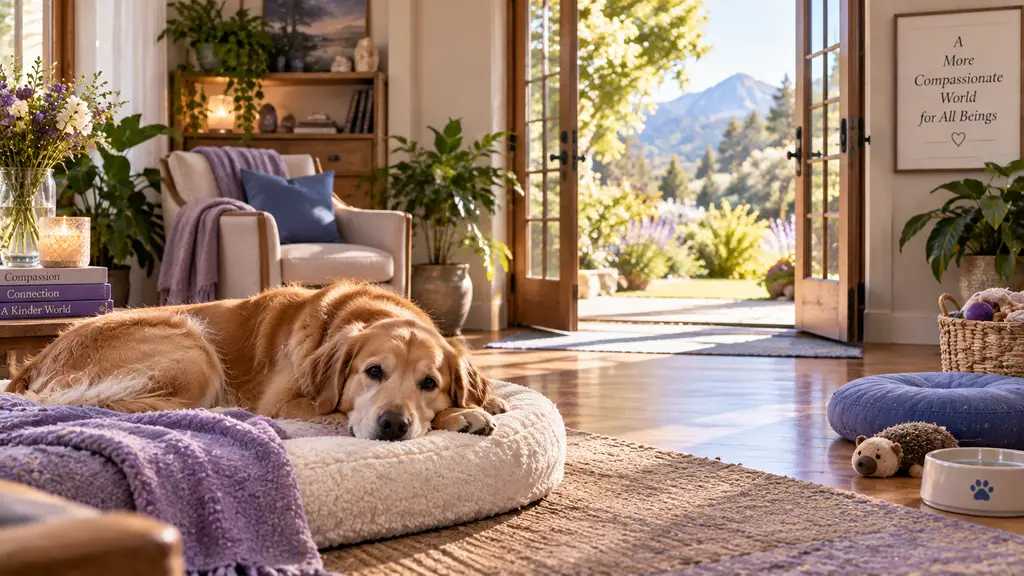
Before Hands, Notice the Room
It is easy to arrive with a mental image of how the session should happen. We may imagine the animal lying on a bed while we sit a few feet away. But the actual environment may tell us something else. The dog may prefer the hallway. The cat may choose a high perch. A horse may want to remain near a companion. A shelter animal may be more settled if the practitioner does not enter the enclosure immediately.
When we begin with the room rather than with our plan, we gather useful information. Where are the exits? What sounds are present? Is the floor slippery? Is another animal moving through the space? Is the animal able to see the practitioner clearly? Is there a location the animal repeatedly returns to? None of these observations tells us what the animal is “feeling” in an energetic sense. They give us visible context that can help us make better practical choices.
Safety Is Part of Reiki Presence
Safety is not less spiritual than intuition. In Animal Reiki, safety is part of responsible presence. An animal may be friendly and still become startled. A gate may be secure until someone opens it. A dog may be comfortable with the practitioner but reactive toward another animal. A horse may shift suddenly because of a sound or movement outside the practitioner’s awareness. The environment can change quickly, and the practitioner needs to remain responsive to what is actually happening.
This is one reason I do not think of preparation as a rigid checklist that we complete and then forget. Safety remains active throughout the session. We keep noticing. We stay aware of exits, body position, other beings in the space, and changes in the animal’s behavior. Reiki does not remove the need for ordinary good judgment.
Give the Animal Real Paths of Choice
Choice only becomes meaningful when there is somewhere to go. If we tell ourselves that an animal is free to leave but we are sitting in the only open doorway, that freedom is limited. If a cat is placed on a table and physically prevented from moving away, we have changed the nature of the interaction. If an animal is surrounded by several people who are all focused on it, the pressure of the environment may become more important than our intention to be gentle.
A useful environmental question is: Does the animal have a real way to create more or less distance? Sometimes the answer is physical. We can move our chair. We can leave an open pathway. We can avoid closing in around the animal. In some professional settings, direct freedom of movement may be limited for necessary safety or medical reasons. In those cases, the practitioner can still reduce unnecessary pressure by changing position, softening attention, shortening the session, or working from outside an enclosure when appropriate.
Reduce Pressure Before You Interpret Behavior
Animals respond to environments for many reasons. Noise, unfamiliar people, smells, flooring, recent activity, another animal, pain, fatigue, hunger, or routine can all influence behavior. If an animal moves away during Reiki, we do not need to immediately decide what that movement means energetically.
The first task is simpler: notice what happened. Perhaps a door opened. Perhaps someone entered the room. Perhaps the animal heard something we did not. Perhaps the animal simply preferred another location. Observation before interpretation helps us avoid turning ordinary behavior into a spiritual story.
That does not make the session less intuitive. It makes our intuition more disciplined. We can remain open to subtle experience while respecting the difference between what we observe and what we infer.
The Caregiver and Household Are Part of the Context
In home sessions, the environment includes people as well as animals. A caregiver may be anxious, talkative, protective, curious, or uncertain about what is supposed to happen. Other family members may enter and leave. Children may want to participate. Another animal may become interested in the session. The television may be on. The doorbell may ring.
We do not need a perfect healing room in order to offer Reiki. We do need enough awareness to decide what matters. Sometimes a small adjustment makes the session easier: lowering the volume, asking that an animal not be repeatedly called back into the room, allowing another animal to stay if everyone is safe, or inviting the caregiver to observe without trying to keep the animal still. The goal is not to control the household. It is to reduce unnecessary pressure so the animal has room to choose.
Observation Begins Before the Session
One of the most useful shifts in Animal Reiki is recognizing that observation starts before we formally begin. How does the animal respond when we arrive? Where do they position themselves? Do they approach immediately or watch from a distance? What does the caregiver tell us about ordinary behavior? Is the animal usually social, cautious, mobile, or sleepy at this time of day?
These observations create a baseline. Without a baseline, we may mistake ordinary behavior for a response to Reiki. A dog that always sleeps at 2:00 p.m. may fall asleep during the session because that is what the dog normally does. A cat that always sits on the same windowsill may go there whether Reiki is being offered or not. That does not diminish the session. It helps us describe it more honestly.
When the Environment Needs to Change
There are times when the most responsible Reiki decision is to change the environment before continuing. If an animal is being harassed by another animal, if the space is unsafe, if too many people are crowding the animal, or if the practitioner cannot maintain appropriate distance, a practical adjustment may be necessary. We may move to another room, work from outside a gate, ask someone to secure another animal, or postpone the session.
Nonattachment applies here too. We do not have to force the session to happen because it was scheduled. The environment may be telling us that another approach would better support consent and safety.
Professional Settings Need More Planning
Shelters, veterinary hospitals, barns, rescues, and other professional settings bring additional environmental considerations. There may be infection-control rules, staff routines, restricted access, frightened animals, equipment, other clients, or safety protocols that must come before our preferred Reiki setup.
Professionalism means working with the environment rather than expecting the environment to reorganize itself around Reiki. Ask what the facility requires. Clarify where you may stand or sit. Learn who is authorized to give consent. Follow the rules of the setting. Respect medical and animal-care staff. Reiki can be flexible without becoming careless.
Reiki Does Not Replace Veterinary Care
Environmental awareness also includes knowing when what we observe requires ordinary care rather than spiritual interpretation. If an animal appears injured, distressed, ill, or in need of medical evaluation, Reiki is complementary and does not replace veterinary diagnosis or treatment. The practitioner’s role is not to explain physical symptoms through energy language. Responsible Animal Reiki includes recognizing scope and encouraging appropriate veterinary care when needed.
We can offer Reiki and still take practical action. Those are not opposing choices.
A Simple Pre-Session Environmental Check
Before your next Animal Reiki session, pause before you begin. Look around and ask a few simple questions. Is the space safe for the animal, practitioner, and others present? Does the animal have a way to create distance? Is there anything obvious creating unnecessary pressure? Are other animals or people affecting the space? What behavior appears normal for this animal before Reiki begins? Is there anything that requires practical action before I offer Reiki?
Then let the answers guide your setup. You may discover that the most useful change is moving your chair six feet away. You may decide to leave the door open. You may ask the caregiver not to call the animal back. You may work from outside an enclosure. Or you may realize that no change is needed at all.
The important thing is that the environment is no longer invisible. Animal Reiki asks us to become attentive not only to the animal, but to the conditions around the animal. Safety, consent, and observation live in real spaces. When we prepare those spaces thoughtfully, we do not guarantee a particular Reiki experience. We create more room for the animal to choose its own.
The environment influences safety, movement, comfort, and the animal’s available choices. Preparing the space thoughtfully can reduce unnecessary pressure and help the animal participate in its own way.
No. A perfectly silent space is not required. The practitioner should notice whether sound, activity, people, or other animals are creating stress or limiting the animal’s ability to choose distance.
It depends on safety and the setting. If an open door gives the animal a safe choice to leave, that may be useful. In other situations, doors must remain closed for safety. The important question is how to preserve meaningful choice within the actual environment.
Follow the facility’s rules, safety procedures, consent requirements, and staff direction. Reiki should adapt to the professional environment rather than interfering with care.
No. Animal Reiki is complementary and does not replace veterinary evaluation, diagnosis, or treatment.